70W C-Band

I need to get back on the roof to swop out bits, it's got rather nippy in the past hour.

I was surprised that the internal noise of the LNB appears to mirror that of any potential 5G interference, which is not present in the flanged C band LNB that was originally outside (Horizon Platinum series - 25K) on the co-rotor.

Have you tried an indoor test to see the ground levels of noise ?

Iv'e done indoor rudimentary frequency range plots of various lnb's using CS and a TBS 6903 card in the PC to get a rough idea of how flat the responses have been - it's not test lab standard of measuring but it does offer a rough guide.
 
The spectrum image is instant. Here's the indoor response from the Horizon LNB.
 

Attachments

  • 20230305_152345[1].jpg
    20230305_152345[1].jpg
    460 KB · Views: 31
Let me ask satellite receiving friends in Brazil and the United States and China.
In the United States, products using 3.8-4.2 GHz are currently being used, but some people say that 3.9-4.2 GHz is also starting to be used. In Australia, products are still in the 3.7-4.2 GHz range. Brazil actually doesn't need 5G as there's no funding for it, and only a few pilot programs are being carried out.
 

Attachments

  • IMG_1676.jpg
    IMG_1676.jpg
    390.5 KB · Views: 25
Analogue signals into the UK from Brazilian beam ....
70° West check for August 6th, '23. - Receiver still suffering from 5G interference in direct line of signal path from 70°W to my QTH North Nottinghamshire UK.
3.720 H PAL.
.......................................................................................................................................................................................................................................................................................................................................................................................................................................................................................................................
Screenshot (225).pngScreenshot (228).jpg
 
Last edited:
5G is so annoying. Especially as I can't even get it!

John, what's the highest PAL frequency you get on that satellite?
 
The highest 70° W frequencys that can be seen here with me at least in the Midlands, but are only visible on the Promax HD Ranger+ meter and not the LT8700 Rx, are way down in strength compared to others lower in the band frequencies.
Highest Hor Pal / Promax display only, no rx lock = 4010 H. - 4030 H. - 4170 H.
Highest Ver Pal / Promax display only, no rx lock = 4010 V. - 4170 V.
 
Last edited:
Thanks John. Not just me or the LNB being deaf at the top end then!

No Alex, i'll get a screen grab asap which shows the big difference between top / bottom of the band
 
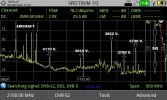
70° West Promax screen grab showing analogue & digital signals into the Midlands UK.
The actual Vertical pol 'live' meter display shows signal amplitudes varying rapidly in real time which the 'still' image does not portray but you get the idea. With the 'live' screen you can see how the very strong 5G pulses washes over the signals around the lower part of the band causing problems. The Hor plot is more or less the same.
...............................................................................................................................................................................................................................................................................................................................................................................................................................................................................................................


SPCH1_70.jaes uk ...jpg
 
It seems like the cutoff for 5g is at around 3700, but still getting interference up to about 3800 here. Do they not have filters or...?
 
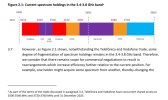
5G in the UK goes up to 3800MHz

Code:
https://www.ofcom.org.uk/__data/assets/pdf_file/0028/217954/notice-reg-121.pdf
Urggh

It doesn't seem to appear in John's scan though, unless I am not reading it correctly.
 
5G in the UK goes up to 3800MHz

Code:
https://www.ofcom.org.uk/__data/assets/pdf_file/0028/217954/notice-reg-121.pdf

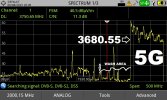
At the moment (touch wood) , my offending 5G rubbish has a cliff edge of 3680.55 but has a destructive wash effect up to 3750 / 3770 GHz area.
My Cband system uses a Norsat 8000RI 3.6 to 4.8GHz extended lnb and i dont use any 5G filtering at the moment - putting a 5G external filter in place will & does kill off the 4.5 to 4.8GHz operation of the otherwise excellent Norsat lnb so i just put up with the interference, which only causes big problems when i'm pointing the dish from say 58° West up to 72°West position, i imagine the 5G frequencies will creep up the band even more in time as you say.
.......................................................................................................................................................................................................................................................................................................................................................................................................................................................................................................................

70 WEST 5G WASH AREA.jpg
 
Urggh

It doesn't seem to appear in John's scan though, unless I am not reading it correctly.
It will depend on which mobile operator owns the offending towers, although sometimes they are shared, if you can find the planning documents they usually give that information. Sometimes they also give antenna bearings and general frequency bands but I haven't seen any locally that give exact frequencies.

347A3FB7-EC22-4FE9-B507-F185111DF20A.jpeg
 
Lately some larger cities already have 5G and soon there will be expansion to other smaller cities. Here in Brazil there are already reports of interference and people are already looking for LNBF with filter.

Still on the analogue signal, there is a specific date for the shutdown because of 5G.

See the 5G map here:

 
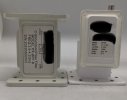
It should be possible to remove the electronics of a C-Band LNBF (or LNB with WR229 flange case) and fit into a bespoke case with a narrower throat.

A WR159 flange has a low pass frequency in the region of 3.7GHz, a throat diameter of 40mm will offer a natural filter from incoming signals below this. An off the shelf flange is however not common in commercial communications useage, the nearest being WR137 - C Band transmit - with a cutoff of 4.3GHz . The equivalent circular throat is 35mm, a sliding scale suggests a diameter nearer 41mm will have a cutoff at the point 5G interference is eliminated.
 
It should be possible to remove the electronics of a C-Band LNBF (or LNB with WR229 flange case) and fit into a bespoke case with a narrower throat.

A WR159 flange has a low pass frequency in the region of 3.7GHz, a throat diameter of 40mm will offer a natural filter from incoming signals below this. An off the shelf flange is however not common in commercial communications useage, the nearest being WR137 - C Band transmit - with a cutoff of 4.3GHz . The equivalent circular throat is 35mm, a sliding scale suggests a diameter nearer 41mm will have a cutoff at the point 5G interference is eliminated.

That certainly is a good experiment suggestion to try and has set my curiousity buds flowing - i think i've got a bit of ~41mm pipe somewhere which will slot into my exising feed throat as a sleeve. Some analyser grabs of full band frequency plots before and after the sleeve has been fitted could be interesting, especially what effect it will have on the 4.5 to 4.8GHz section of my reception as well as attenuation of the bad 5G around 3.680 and lower :Y.
 
Last edited:
If 5G hits the way it hit me, there's no filter that can help whatsoever.
 
That certainly is a good experiment suggestion to try and has set my curiousity buds flowing - i think i've got a bit of ~41mm pipe somewhere which will slot into my exising feed throat as a sleeve. Some analyser grabs of full band frequency plots before and after the sleeve has been fitted could be interesting, especially what effect it will have on the 4.5 to 4.8GHz section of my reception as well as attenuation of the bad 5G around 3.680 and lower :Y.


Looking forward with interest to your experiment results.

Question 1.
If shimming the inside of an existing feed, I assume it will diminish the surface area of the detector probes visible to the signal?
Is it the entire length of the probe that gathers signal or does only a fraction of it need signal?

Question 2.
Is there going to be any difference between shimming the entire internal length of the feed to the probes/end point compared to shimming the first couple of inches in from the feed rim aperture?
 
Looking forward with interest to your experiment results.

Question 1.
If shimming the inside of an existing feed, I assume it will diminish the surface area of the detector probes visible to the signal?
Is it the entire length of the probe that gathers signal or does only a fraction of it need signal?

Question 2.
Is there going to be any difference between shimming the entire internal length of the feed to the probes/end point compared to shimming the first couple of inches in from the feed rim aperture?

From your personal experience did you find that the 'entire internal length' was better or just 'the first couple of inches' ... asking for a friend
 
Back
Top