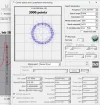
Dror 1 launch july

Both muxes, 11383 H and 11402 H, are on the spectrum as soon as I moved the antenna a little (2 steps) further west.
11402 h has a slightly weaker signal but is locatable.

We need to determine why the copy from 11383 H has a much weaker signal than 11133 H. Could it be in a different spot? And if so, is it on Amos 3 or Dror1?
 

Attachments

  • 4.0W_11402 H,27000,34,32apsk-2025-08-15_11-51-26.webp
    4.0W_11402 H,27000,34,32apsk-2025-08-15_11-51-26.webp
    167.1 KB · Views: 109

Attachments

  • 11440 h_2025-08-07_12-41-21.webp
    11440 h_2025-08-07_12-41-21.webp
    66.6 KB · Views: 37

Attachments

  • 11440 H_2025-08-15_12-13-36.webp
    11440 H_2025-08-15_12-13-36.webp
    97.7 KB · Views: 38
Thank you for the demonstration.
It is good to know about your tests with the two transponders and their positions.
However, we still do not know for certain which of the two is on Dror-1.
Just my experiences... 11383 H is two steps more east as others (11402 H; 11419 H; 11421 H)...

...
Thank you for the demonstration. It is good to know about your tests with the two transponders and their positions.
However, we still do not know for certain which of the two is on Dror-1. 11402 H is likely on it.

Moreover, why does the copy at 11383 H have a weaker signal regardless of the antenna used by each of us and the area where we receive it?

What makes it challenging to determine the position of both muxes is that they are active/operational. They are no longer test carriers.
 
If anyone is in the Middle East, please test the signal on the two active transponders: 11383 H and 11402 H.
I can infer that the weak signal we are receiving in Europe (see reports by @dreamsat, @QWER, @Marcus_21, and me) is being transmitted from this spot.

I would be interested to know this, because the signal from the horizontal pol on this Amos spot could previously be received on our continent. This thing is true in many cases at the limit.
I think it's a hypothesis worth considering(?).
 
They are turning on every now and then, a test carrier on the frequency 11146 H.

4.0W-RFScan_60206.webp 4W_11146_H.webp
 
Last edited:
At this moment, the 11141 V test carrier is active.
 

Attachments

  • 11141 V-test carrier_2025-08-15_21-36-20.webp
    11141 V-test carrier_2025-08-15_21-36-20.webp
    62.7 KB · Views: 28
Both muxes, 11383 H and 11402 H, are on the spectrum as soon as I moved the antenna a little (2 steps) further west.
11402 h has a slightly weaker signal but is locatable.

We need to determine why the copy from 11383 H has a much weaker signal than 11133 H. Could it be in a different spot? And if so, is it on Amos 3 or Dror1?
11402 H,27000,3/4, 32APSK came back with a stronger signal than before.
But that doesn't help me determine which spot to cover.

Instead, 11383 H is reported on FlySat, but without specifying the coverage area.
 

Attachments

  • 11402 H,27000,34,32apsk-gs_2025-08-19_20-38-44.webp
    11402 H,27000,34,32apsk-gs_2025-08-19_20-38-44.webp
    77.9 KB · Views: 24
  • 11260-11425 H_2025-08-19_20-51-54.webp
    11260-11425 H_2025-08-19_20-51-54.webp
    42.9 KB · Views: 35
Any member can be check ka band and x band of dror 1

Checked Ka Band D Hor just now at 21.31 and nothing seen as yet.
 
In middle east i got this data tp @ 4w
10983
V
14150
Not quite sure if it's Dror or 3w
 

Attachments

  • 20250830_003351.webp
    20250830_003351.webp
    570.8 KB · Views: 31
Last edited:
No signal on these parameter for my setup and place (2.2m southwest Germany) between 3.0°W to 5.0°W.
 
Back
Top