My go at WXSAT

Annoyingly, the FM reception is fine, plus all the confifuring settings do have an effect on the reception, so its not the stick.

 
I have noticed that I am sometimes getting HVC images saved from NOAA 19.
Two N 19 scans today saved them.
N 19 47 E MEL 8 E LONG 14:50 Northbound.
N 19 37 W MEL 15 W LONG 16:31 Northbound
noaa-19-11061631-hvct-precip.webp
 

Attachments

  • noaa-19-11061631-hvc.webp
    noaa-19-11061631-hvc.webp
    101.1 KB · Views: 1
  • noaa-19-11061631-hvc-precip.webp
    noaa-19-11061631-hvc-precip.webp
    115.2 KB · Views: 2
  • noaa-19-11061631-hvct.webp
    noaa-19-11061631-hvct.webp
    100.7 KB · Views: 1
If I get time later this week I'll try connecting the stick to the discone thing up on the roof.
 
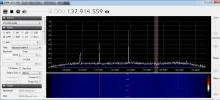
@Channel Hopper set the bandwidth to 41000 not 41.000. Your bandwidth is too narrow - the vertical frequency line should cover the horizontal width of the wxsat transmissions. If you have any suitable amp (lna4all maybe) - stick that in circuit.

Untick the IQ box as well

There is a way to get the vac to pass audio - Ive managed it once a while back although it involved tinkering deep in the soundcards settings . And Vipersan definitely posted some instructions on running mulitple vacs to listen to the audio whilst piping it on one of his threads.
 
Last edited:
My settings - without an amp you may need to play with the gain settings.

Capture.webpCapture1.webp

If you want any of the other settings just say :) Freq correction is dongle specific so dont worry too much about that one.
 
Last edited:
If you want to use the doppler tracking of Orbitron you have to use an early version of SDR# (Im using 1361) as it was discomtinued in later releases. You download the tracking plug in, add the magic line to the SDR# config xml and restart it.

NOAAS 15 & 18 are currently passing Europ at approximately the same time so choose one or the other to follow. Some good software for tracking is David Taylor's Wxtrack. The free version is perfectly fine for what we need - note 15 & 18 in close proximity:

Capture.webp
 
Thanks

The SDR version (1672) I have includes the comma within the bandwidth settings, it cannot be removed and so I think I have 40kHz set.
The gain setting works well on FM so I don't think I need to do much apart from set just over half way as normal, this setting allowed me to hear the satellite four days ago.

As for the rest, these have been altered and I will try for NOAA 18 in just over 40 minutes as it is going to be a very high pass.
 
Perhaps it being the beta SDR version I have a stability issue ?
 
You more then likely need a better antenna for the NOAA birds, I tried several ham and discone options till I built an antenna suited for the circular polarized signals from the satellites, also getting the antenna above the local ground clutter helped quite a bit.
 
Perhaps, though it is odd that I managed a reasonable signal on the very first pass, since then it's all been downhill, even with a matched length antenna for 2m work.

I am testing on the first floor on each pass, east is out of the bathroom, west is via the bedroom, but if it ever dries up I will take the antennas onto the roof.

What I don't have currently is a matching plug for the socket on the SDR unit I am currently using, it's much smaller than SMA and is a push fit.


With luck by the weekend I can swop out the current stick for the NooElec one I bought last year (NESDR Smart) which has a far better construction, including a 'proper' screw-in terminal at the sharp end, with which to bolt on the antenna array I have on the roof.
 
A 2m antenna should work reasonably well - I was getting fairly good Wxsat signals on my 145MHz dipole last weekend. Signal levels were down a fair bit as I hadnt got the wxsat amp in line but should work ok for testing. You havent snapped the central pin off the dongle antenna connector have you - I did that on one of mine and knackered it - Im using the screw on NESDR Smart ones now - they are a bit more expensive but also more robust.
 
A 2m antenna should work reasonably well - I was getting fairly good Wxsat signals on my 145MHz dipole last weekend. Signal levels were down a fair bit as I hadnt got the wxsat amp in line but should work ok for testing. You havent snapped the central pin off the dongle antenna connector have you - I did that on one of mine and knackered it - Im using the screw on NESDR Smart ones now - they are a bit more expensive but also more robust.


I'Il check tomorrow but as all other tests have brought signal I doubt it. I can test both sticks side by side at the weekend regardless.
 
I have been getting a lot of poor scans recently,even though the signal from Airspy looks good.I was thinking that perhaps the antenna had moved in the winds or water had got into the one inline cable connector.I have reinstalled older images incase I had upset Wxtoimg somehow.More likely it is the weather or low flying sats.:)This is the best scan that I have had for a while.NOAA 18 18:38.
Edit I have not spent a lot of time on this.My time is split with Wxtoimg and Chasing cube sats not having much success there either.:(
noaa-18-12121838-mcir-precip.webp
 

Attachments

  • noaa-18-12121838-norm.webp
    noaa-18-12121838-norm.webp
    31.8 KB · Views: 1
Last edited:
The black linmes across the top half are probably local interference (pagers at a guess) Heres my image of the same pass - note the weak signal is in almost but not quite the same place down the bottom which is interesting

12121836.webp
 
Work is nuts atm which is leaving me rather frazzled but I will be more than happy to see if we can get your cubesat reception sorted over the Christmas holidays if you are around. And CH's issues as well. I suggest a new thread for that one where we can compare programme settings etc. :)
 
I am very near the hospital, an industrial estate is not far away so I think that I have a lot of pagers here.On northbound passes I always get low signal at the start of the pass as shown on the 20:18 N 18 pass.
noaa-18-12122018-mcir-precip.webp
 

Attachments

  • noaa-18-12122018-norm.webp
    noaa-18-12122018-norm.webp
    44.4 KB · Views: 1
Thats maybe a house or large building getting in the way weakening the signal on the lower part of the passes I have problems on the low south & south east passes here because of the hills in the way.
 
On low passes it could be signal reflection, this will cause drop outs, it also could be ground clutter.

Try raising the start and stop elevations in the recording options, playing with different settings can reduce this problem.(this may take some time)

I have mine set to 15/24, this stopped most of the clutter at the start and stop of the recording.

For ground clutter you may need to raise the receiving antenna higher.
 
Back
Top