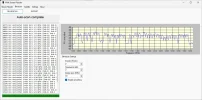
VMA Stream Reader

This streaming not automaticaly call TransEdit (must manual run TE)
Yes! I forgot to say that the streaming client needs to be started manually...
 
when i push "Start Streaming" nothing happens (i tested it with transedit and TSreader since i've got no license for your VMA Transport Stream Analyser.)
I tried sniffing my network too but no udp packets on 127.0.0.1:1234

Did i miss something?
How did you configure TranEdit or TSR to receive UDP packets?
 
I introduced a bug (not sure what happend) which broke streaming...
 
@vma,

There is no rush to have both polarities on your SR. Still, even if you haven't thought about it, your excellent suite of applications (VMA UDPP Splitter, TS HUB, Multiplexer, etc.) is a kind of portal that helps enthusiasts capitalize on the signals they receive, most importantly, streams with different content.
Thanks for all :-respekt
 
Hello,
I'm very happy with the application so far. Not everything can work right away, and different users have different perspectives and operating preferences. I think VMA will continue to improve this tool and fulfill some of the wishes of others. I think a lot of work has gone into this program, and if, like me, you have no clue about programming, you're glad that there are such capable developers like VMA.

best regards
 

Attachments

  • VMA_13.webp
    VMA_13.webp
    196.8 KB · Views: 20
  • VMA_14.webp
    VMA_14.webp
    174.8 KB · Views: 16
Can someone please confirm if the streaming works with the last version? I am not at home now and this is bugging me.
 
The last option worked for me. I just had to start the Transport Stream Analyzer separately.
 
Ok. Perhaps I have a dead process blocking port 1234. Will test when I get back. Has been a difficult day for development. Lots of work requests.

EDIT: Port 1234 was blocked. No bug! :p
 
Last edited:
New version: https://vma-broadcast.com/wp-content/uploads/2025/04/VMA_Stream_Reader_20250716.zip

Initial Satellite configuration handling and DiSEqC support.

Notes:
  • LOF1/LOF2/LOFSW from Satellite configuration are not used, yet - the Default values are used
  • USALS not supported, yet (I have no idea how this works)
  • Only DiSEqC-1.2 was tested - please provide feedback for ToneBurst/DiSEqC-1.0/1.1
  • Multiple DiSEqC command configuration should work, but has not been tested
Yes, I did inspire myself on how crcj implemented this in EBSpro and he deserves credits for the very usable DiSEqC layout!

1752656067398.webp

This blindscan took 1 minute and 3 seconds (initial spectrum scan not considered):

1752656214429.webp

The blindscan setttings used were Smooth Window = 2, Treshold Delta = 3 and Cluster span = 10.

This is the exported *.ini file:
1752656290590.webp

As already observed, only one polarity is processed by the blind scan - the polarity used for the spectrum scan.

I will probably add an advanced blind scan, that will scan all configured satellites on both polarities.

I have a question: Is it enough to consider H/V? Do other polarities (CL/CR, etc.) matter at all?
 
For me Diseqc 1.1 does not work.
Analyzing the streamreader.log you send the command
Code:
E0 10 3B F0
but if i look at AltDvb log (where Diseqc 1.1 works) the command sent is
Code:
 E0 10 38 FE
.

Can you take a look?
Bye and thanks!
 
I have a question: Is it enough to consider H/V? Do other polarities (CL/CR, etc.) matter at all?

To me CL& RL matter very much.
 
For me Diseqc 1.1 does not work.

Analyzing the streamreader.log you send the command
E0 10 3B F0

but if i look at AltDvb log (where Diseqc 1.1 works) the command sent is
E0 10 38 FE

Can you take a look?


E0 10 38 (not 3B ) xx would concern diseqc 1.0.

E0 10 39 xx would concern diseqc 1.1 (I guess xx = F0 to FF, for switch ports 1 to 16).

So it should be looked at, indeed.

Greetz,
A33
 
Last edited:
Diseqc 1.1 doesn't work for me eithera2.webpa1.webp
 
Fantastic job @vma!
Could you please consider the usage with screen readers? This would massively improve accessibility, that's an issue with most existing tools (maybe other than EBSPro).
I know this is not simple due to many graphics representations, but maybe something can be done in many screens. Thanks.
 
Fantastic job @vma!
Could you please consider the usage with screen readers? This would massively improve accessibility, that's an issue with most existing tools (maybe other than EBSPro).
I know this is not simple due to many graphics representations, but maybe something can be done in many screens. Thanks.
Please specify how I can help.
 
E0 10 38 (not 3B ) xx would concern diseqc 1.0.

E0 10 39 xx would concern diseqc 1.1 (I guess xx = F0 to FF, for switch ports 1 to 16).

So it should be looked at, indeed.

Greetz,
A33
I am away from home office today and tomorrow, so time is reduced. I will fix DiSEqC 1.1 as soon as possible.

Please explain how polarity is relevant for more than H/V? what is the difference of H/V or L/R in terms of the software side?
 
I have this idea spinning in my head: using a TinySA/TinySA Ultra, connected with a splitter and a DC blocker (very important to avoid blowing the input stage) to the satellite card, a software would start at the Eastern limit (driven manually) and rotates until the Western limit (hard coded on the rotor by the user). Whenever it detects a spectrum which has an integral (area below the spectrum) greater than the normal noise floor, we are in presence of a satellite. With fine tuning this could be optimized for best reception. The software would store all found satellites starting at position 1 up to the max. position (28 with Moteck, if I am not mistaken). The setup requires a computer, a DiSEqC-1.2 driven dish, a compatible card (CrazyScan Streamreader.DLL) and a TinySA/TinySA Ultra.

Is this something that you guys would find interesting?

Another idea I have is to implement a more complete blind scan based on pattern recognition (like the one that already exists) but which scans all programmed satellites in both H and V polarity. For each satellite/polarity a new spectrum scan is required. This should reduce the blind scan time to about 3 minutes per satellite. 20 Satellites would be scanned in an hour. Is that good? I normally don't care much about blind scan, hence why I am asking).
 
Back
Top