vma
Regular Member
- My Satellite Setup
- Main dish: 120cm No-Name, Motek SG-2100A, Bullseye LNB
- My Location
- Portugal
You need to understand how this works and accept that it doesn't do miracles:
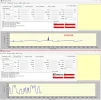
It looks at the spectrum curve and determines the "spikes" by first averaging the curve to remove noise. Then it checks any spike greater than the delta value relative to its neighboring samples. Finally it filters any "spike" found that has a width which is less than the specified bandwidth. Now it does a blind scan on the determined frequency.
The aim is not to find transponders which a "brute-force" blind scan (which checks every frequency from start to end with a given step) doesn't find. Instead, the algorithm tries to do it much faster by finding all transponders by just "looking" at them, selecting each and only do a blind scan on those.
Next I want to allow scanning all selected satellites on the selected polarities. The main issue is I don't know how long to wait for DiSEqC to finish rotating a dish (or whatever). Perhaps I will start by replacing the existing implementation and make it do auto scan for selected polarities on the current satellite. This will repeat the spectrum scan, in case it was already done, but on the other hand it will find (almost) all transponders of the entire satellite, thus creating complete *.ini files.
I have ideas on how to do an in between algorithm: filter out all frequencies below a given threshold and only do a brute-force blind scan on the remaining frequencies, with a given step size, which should speed up the blind scan on exotic satellites (but would take the same time on satellites like 19.2E, 13.0E, etc., since all frequencies are used by transponders).
As you guys understand all of this is a lot of work. When I get enthusiastic, I end up not sleeping to implement everything as fast as possible, but after some time I need to stop, to recover myself and get a grip for everything else happening around me.
It looks at the spectrum curve and determines the "spikes" by first averaging the curve to remove noise. Then it checks any spike greater than the delta value relative to its neighboring samples. Finally it filters any "spike" found that has a width which is less than the specified bandwidth. Now it does a blind scan on the determined frequency.
The aim is not to find transponders which a "brute-force" blind scan (which checks every frequency from start to end with a given step) doesn't find. Instead, the algorithm tries to do it much faster by finding all transponders by just "looking" at them, selecting each and only do a blind scan on those.
Next I want to allow scanning all selected satellites on the selected polarities. The main issue is I don't know how long to wait for DiSEqC to finish rotating a dish (or whatever). Perhaps I will start by replacing the existing implementation and make it do auto scan for selected polarities on the current satellite. This will repeat the spectrum scan, in case it was already done, but on the other hand it will find (almost) all transponders of the entire satellite, thus creating complete *.ini files.
I have ideas on how to do an in between algorithm: filter out all frequencies below a given threshold and only do a brute-force blind scan on the remaining frequencies, with a given step size, which should speed up the blind scan on exotic satellites (but would take the same time on satellites like 19.2E, 13.0E, etc., since all frequencies are used by transponders).
As you guys understand all of this is a lot of work. When I get enthusiastic, I end up not sleeping to implement everything as fast as possible, but after some time I need to stop, to recover myself and get a grip for everything else happening around me.