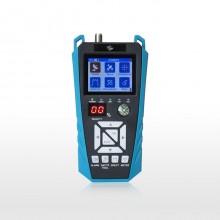
New meter needed

something I never checked (or needed really) it certainly identified channels on SD transponders
That would be the clincher over whether a repair is worthwhile.

As per VMA's post I bought an almost unused emitor SatLook Digital NIT last year for around £70. All it required was a new battery. No HD but so far it does an excellent job under the TV, verifying the dishes are centred on orbital slots since the USALS commands don't always send the dish to the correct spot.
 
The Satlook Micro only switches on if the battery has some power left. Even if it is at the end of its life, if it can hold a little charge, it will power on the meter and then the power brick will keep it alive. If you remove the battery or if it is completely dead, the meter won't start.

You can easily buy a new battery pack on AliExpress for 12 Euro (8.59£ 30% OFF|( X Model ) 12v 1800mah Nimh Battery For Rc Toy Car Tanks Trains Robot Boat Gun Ni-mh Aa 1000mah 12v Rechargeable Battery 1pcs - Rechargeable Batteries - AliExpress) with free shipping.

Note that the connector is wrong and has only two wires: that is because the thermal probe is missing. You can use the one in your dead battery. Just place it at the same spot under the shrinkwrap and then transfer the old connector to the new battery.

I think that is the cheapest way to get you back up and running.

Being able to support DVB-S2 transponders is nice, but, in my experience, not fundamental: the Satlook Digital NIT's main functionality is the rerally fast spectrum display and resolution, together with the DiSEqC-1.2 support.

I have both the Satlook Color and the Satlook Color HD. While the HD is certainly better in being able to lock to DVB-S2 transponders, show the constellation and identify NIT/channels, you would be able to perfectly align the dish with the non-HD model.

 
Being able to support DVB-S2 transponders is nice, but, in my experience, not fundamental: the Satlook Digital NIT's main functionality is the rerally fast spectrum display and resolution, together with the DiSEqC-1.2 support.
Yes, that was the strength of the Satlook NIT I had some years back, a fast reacting spectrum, great for dish alignment once you could recognise the traces of the common satellites.:) Great for the hobbyist, for motor installations I'd use a little inline DiSEqC motor module, in fact still use it now for with Promax to drive the dish, as much easier than using the meter.
 
Yes, that was the strength of the Satlook NIT I had some years back, a fast reacting spectrum, great for dish alignment once you could recognise the traces of the common satellites.:) Great for the hobbyist,....
Oi!

It's still doing sterling work in the field.
 
The Satlook Micro only switches on if the battery has some power left. Even if it is at the end of its life, if it can hold a little charge, it will power on the meter and then the power brick will keep it alive. If you remove the battery or if it is completely dead, the meter won't start.

You can easily buy a new battery pack on AliExpress for 12 Euro (8.59£ 30% OFF|( X Model ) 12v 1800mah Nimh Battery For Rc Toy Car Tanks Trains Robot Boat Gun Ni-mh Aa 1000mah 12v Rechargeable Battery 1pcs - Rechargeable Batteries - AliExpress) with free shipping.

Note that the connector is wrong and has only two wires: that is because the thermal probe is missing. You can use the one in your dead battery. Just place it at the same spot under the shrinkwrap and then transfer the old connector to the new battery.

I think that is the cheapest way to get you back up and running.

Being able to support DVB-S2 transponders is nice, but, in my experience, not fundamental: the Satlook Digital NIT's main functionality is the rerally fast spectrum display and resolution, together with the DiSEqC-1.2 support.

I have both the Satlook Color and the Satlook Color HD. While the HD is certainly better in being able to lock to DVB-S2 transponders, show the constellation and identify NIT/channels, you would be able to perfectly align the dish with the non-HD model.
It's not the battery, that was renewed a couple of years back, and also I have done numerous install with it attached to the charger when the battery died on a job.
It won't power up even on the charger now, just keeps booting up - then it says "low battery" and shuts down. Then endlessly repeats that loop.
The usual pattern of lights as it charges just goes random and it keeps repeating the above pattern/loop.
And yes, I have been able to perfectly align dishes with it for many years, never needed the HD functionality of later models.
Time for a new meter, I think
 
Can you do a simple test: connect 12V DC to the battery connector and see if the meter powers up normally. I still believe the problem is a totally dead battery. Apart from your desire to get a new meter (fully understand that), I would be interested to know if I am right on this.

Back to your original question, while I don't own a Dr.HD1000, I do own the Dr.HD900 model. It works, but is nowhere near a professional meter. My experience with chinese low-cost meters has been transversally bad. They break on their own, even if you don't use them. The rubber of the keys starts to melt, the battery is garbage and one meter even had a fake spectrum: you could disconnect the cable and it would show the satellite spectrum for another 5 seconds...

There have been good deals on Ebay, even for new meters. Here is one (I have no association to the seller and have no idea if he is serious): Spaun Sparos 707 Touch DVB-S und DVB-S2 abs. neuwertig | eBay

A brand that has good meters at affordable price (for professionals) is Prime Digital - Rover Instrument's own OEM brand for lower cost models.
 
Can you do a simple test: connect 12V DC to the battery connector and see if the meter powers up normally. I still believe the problem is a totally dead battery. Apart from your desire to get a new meter (fully understand that), I would be interested to know if I am right on this.

Back to your original question, while I don't own a Dr.HD1000, I do own the Dr.HD900 model. It works, but is nowhere near a professional meter. My experience with chinese low-cost meters has been transversally bad. They break on their own, even if you don't use them. The rubber of the keys starts to melt, the battery is garbage and one meter even had a fake spectrum: you could disconnect the cable and it would show the satellite spectrum for another 5 seconds...

There have been good deals on Ebay, even for new meters. Here is one (I have no association to the seller and have no idea if he is serious): Spaun Sparos 707 Touch DVB-S und DVB-S2 abs. neuwertig | eBay

A brand that has good meters at affordable price (for professionals) is Prime Digital - Rover Instrument's own OEM brand for lower cost models.
If I could save this meter, then I have no need to upgrade to anything else.
Not sure how to get 12v to the battery terminal, I have an old motorcycle battery but that might still be outputting around 14v last time I checked
 
Just connect a 12V power supply to the battery connector of the meter. Use some wires and make sure you don't mix polarity (+ and -).
 
A 14V input will be OK, the meter uses burglar alarm batteries that are lead acid in solid form. They can be around 13.8V when fully charged.
 
A 14V input will be OK, the meter uses burglar alarm batteries that are lead acid in solid form. They can be around 13.8V when fully charged.
That is not correct. The Satlook Micro uses a NiMH battery pack composed of 10x 1.2V AA NiMH batteries. It has a thermal probe inserted as a security feature for the charging cycle, hence the four wires.

14V might not break it but strain the circuit.

The Satlook Digital and Satlook Digital NIT use lead acid batteries,as you mention. This is very convenient because they are really cheap and easily available.
 
Just to add: the Satlook Digital is almost the same as the Satlook Digital NIT, but it lacks the NIT string on the front of the device and, more importantly, the NIT PCB.
This PCB is responsible for the NIT function that shows, after a successful signal lock, the satellite name and the channel list.
I would not purchase the Satlook Digital, because it's price will be the same as a Satlook Digital NIT. It is nice to see the satellite name and the channels on a DVB-S transponder, especially on less popular satellites.
 
That is not correct. The Satlook Micro uses a NiMH battery pack composed of 10x 1.2V AA NiMH batteries. It has a thermal probe inserted as a security feature for the charging cycle, hence the four wires.

14V might not break it but strain the circuit.

The Satlook Digital and Satlook Digital NIT use lead acid batteries,as you mention. This is very convenient because they are really cheap and easily available.
This thread from a few years back


One of the posts mentions a 12V input for the Emitor meter that has a battery pack rated at 9.6V, though I would doubt this is just for the charging circuit.
 
how do they compare to those v8 finder pros going on ali


Wow, does anyone know if these are any good? I've seen some negative stuff about the (presumably) original version, but not so much about this "Pro 2" one, it could well be identical I suppose. I'm seriously tempted at that price, plus with the AliExpress Black Friday deals at the moment.

The DVB-T/2 would be a bonus, but if it's as some of the reviews I've seen it's deaf as a post :D
 
Wow, does anyone know if these are any good? I've seen some negative stuff about the (presumably) original version, but not so much about this "Pro 2" one, it could well be identical I suppose. I'm seriously tempted at that price, plus with the AliExpress Black Friday deals at the moment.

The DVB-T/2 would be a bonus, but if it's as some of the reviews I've seen it's deaf as a post :D
I'm tempted and if deafness is the only problem, that's easily fixed with an external amp. It's easy enough to compensate for gain. If it's something like the demod being rubbish, that rules it out.
 
Last edited:
I'm tempted and if deafness is the only problem, that's easily fixed with an external amp. It's easy enough to compensate for gain. If it's something like the demod being rubbish, that rules it out.

It comes to £52.04 all in (including VAT) if you add the 23AE06 code mentioned on the page at checkout (that takes off £5) - a £3 off every £15 spent auto-applies at the same time so the total discount is £14. Very tempting!
 
sorted, I bought the Primesat FS-700 DVB-s2 Mk2..
 
Back
Top