I name ; a question

MrDish1

Member
My Satellite Setup
Delta Star
My Location
Qth:Aalten
I have a question for you guys.
Who among you has made a setup so that, when standing behind the dish, you can adjust the arms to which the feedhorn is attached for the best signal? I haven't found it on the internet yet. Or maybe I'm looking in the wrong place. So, not the constructions with servo motors and small gears around the LNBs.

Kind regards
 
standing behind the dish, you can adjust the arms to which the feedhorn is attached for the best signal
This is not right approach! You firstly need to install feedarms and feed, and afterward move the antenna left-right-up-down to get maximum signal. Of course, you will also need to adjust skew of the feed.
 
I am not asking for the right approach.
Who has that, which is what I asked about!

Kind regards
 
Normally the arms come with the dish. They have the right size and don't need to be adjusted.
 
Normal, yes.

But being creative is also fun, and it doesn't always have to be (crystal-clear). Like a construction kit. Let your imagination run wild.
 
Normal, yes.

But being creative is also fun, and it doesn't always have to be (crystal-clear). Like a construction kit. Let your imagination run wild.
One problem is that you may need to adjust the angle of the LNB at the same time as you would shorten/lengthen the arms.

U understand why it would be interesting to experiment with what you ask, but have not seen it.
 
( A problem is that you have to adjust the angle of the LNB at the same time as shortening or lengthening the arms.)

Don't worry, nothing will happen to that.
 
( A problem is that you have to adjust the angle of the LNB at the same time as shortening or lengthening the arms.)

Don't worry, nothing will happen to that.
Linear actuators, an ESP32 and a phone app?
 
So, to see if I understood what you want:

1782459763273.webp
You mean to replace the rods holding the LNB with rods that have long threads and then you can adjust the length.
The picture is exaggerated, but it shows that the purpose of this is to tilt the LNB to compensate for a badly aligned dish.
The problem I see is that you have three rods at 120º distance. Aligning the LNB for best performance will require to regulate all three rods, which is not easy. It requires increasing the holes for the rod, so they have some freedom to move. This then requires one screw on each side of the dish, two per rod.
I would not say this is a stupid idea: for a big dish, it could be used to fine tweak maximum reception as opposed to azimuth/elevation rotation of the whole dish.
 
Sorry, but I don't see a problem.

I just use the same holes where the rods were. And instead of rods: M8 or M10 threaded rod.

And that's how you adjust the whole thing.
 
You need to allow for some movement: if you shorten one rod, it's angle regarding the dish changes and it requires an oval hole instead of a circular hole. Also, I am not sure if you need to change the LNB fixture to allow for changing angles of the rods.
 
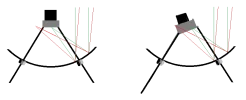
1782471691639.webp
This rough sketch ilustrates that the LNB must be moved in multiple directions. If you only "tilt" it by changing the length of just one rod, it will not be at the correct f/D distance. The sketch is exaggerated and the red lines should hit the center of the LNB (but with the wrong length).
 
I am not in panic. I am just thinking about this out of curiosity.
 
My computer does it for me in one plane. It would be fascinating to see it do it in two by adjusting three actuators.
2026-06-26 15:11:11,085 - INFO - Moved dish to position: 880 steps
2026-06-26 15:11:12,616 - INFO - Signal: 8.25 dB (50.0%), BER: 0, AGC: 97.0%
2026-06-26 15:11:12,616 - INFO - ✓ Ultra-fine tuning improved! New best: 8.25 dB at 880 steps
2026-06-26 15:11:12,627 - INFO - Moved dish to position: 880 steps
2026-06-26 15:11:14,128 - INFO - Testing ultra-fine adjustment: 872 steps
2026-06-26 15:11:14,172 - INFO - Moved dish to position: 872 steps
2026-06-26 15:11:15,714 - INFO - Signal: 8.25 dB (50.0%), BER: 0, AGC: 98.0%
2026-06-26 15:11:15,715 - INFO - ✗ No improvement at 872 steps (signal: 8.25 dB)
2026-06-26 15:11:15,751 - INFO - Moved dish to position: 880 steps
 
My computer does it for me in one plane. It would be fascinating to see it do it in two by adjusting three actuators.
2026-06-26 15:11:11,085 - INFO - Moved dish to position: 880 steps
2026-06-26 15:11:12,616 - INFO - Signal: 8.25 dB (50.0%), BER: 0, AGC: 97.0%
2026-06-26 15:11:12,616 - INFO - ✓ Ultra-fine tuning improved! New best: 8.25 dB at 880 steps
2026-06-26 15:11:12,627 - INFO - Moved dish to position: 880 steps
2026-06-26 15:11:14,128 - INFO - Testing ultra-fine adjustment: 872 steps
2026-06-26 15:11:14,172 - INFO - Moved dish to position: 872 steps
2026-06-26 15:11:15,714 - INFO - Signal: 8.25 dB (50.0%), BER: 0, AGC: 98.0%
2026-06-26 15:11:15,715 - INFO - ✗ No improvement at 872 steps (signal: 8.25 dB)
2026-06-26 15:11:15,751 - INFO - Moved dish to position: 880 steps
What's stopping you from making or doing that?
 
One problem is that you may need to adjust the angle of the LNB at the same time as you would shorten/lengthen the arms.

U understand why it would be interesting to experiment with what you ask, but have not seen it.
It would have been part of the manual correction for multiple LNBs on a fixed offset dish.

IRTE built a motorised unit (Zetec ?) but was linear only.

This was many years ago however, the professional systems will always have motor adjustment on the reflector, including skew for best performance, the feed remains a fixed distance away as per parabolic formula.
 
I would not say this is a stupid idea: for a big dish, it could be used to fine tweak maximum reception as opposed to azimuth/elevation rotation of the whole dish.
You are aware of this, but people who have not used a big dish often underestimate how finely you can tune on each satellite at an orbital position.
 
Back
Top