Receiver that can talk to a Ka band LNB

NoviceSat said:
Note to admins - sorry if I've created lots of posts I was having problems attaching pictures to my message.

No worries, I am very impressed you are trying this so far west, though from the threads that have included technical detail of the Ka beam technology previously, you are almost certainly testing the Beaufort with urine.
 
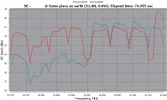
strs65 - if you look at the 1st picture I was using Ka Inverto LNB setting. I only did the second picture using Ku mode as zg3409 asked me to try using Ku settings. As very few devices support Ka it is often less confusing to use Ku values!

Channel Hopper - don't you mean so far east? It is disappointing as I was hoping I'd get lucky being in between the two spots. However when I compare my scans with zg3409 I notice that the jamming signal is the same strength as the data humps, but 'real' Saorsat is -4 dBm lower. So I guess even being in the middle and getting both spots the jamming signal is going to win.

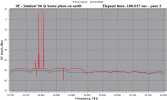
The final thing I noted whilst scanning on Ka was that light aircraft flying nearby seriously upset the Crazyscans I was doing at the time. An aircraft might cause one spike as it blocks the satellite signal but I have one crazyscan with 5 spikes on it! (RF level spiked from -48dBm to +6dBm)
 
On my scan I got lots of spikes. I just kept scanning until the display showed no spikes. I am not sure where the spikes come from but it may be an inability of the receiver to change frequency quick enough. I haven't noticed any light aircraft. However when I use a professional spectrum analyser I never get the spikes. So I would just keep rescanning until the spikes go away.

I did notice in one of your scans there seems to be a spike when the scan goes from low band to high band. At this point the 22Khz signal is turned on and this may have caused a spike in the readings.
 
I think the spike in the Ku scan where the 22KHz tone was turned on was because this put us in the middle of one of the data humps (comparing that scan with the Ka scan). I have attached a scan of what happened when an aircraft went by.

Some aspects of Crazyscan I really like - I've just got round to turning on the USALS support in it. Other aspects I don't like - it seems to crash if you try to move 'focus' onto another program, and it often won't terminate itself (via taskmgr or command line) until you unplug the USB device. I am running version 1.0.1.50. I am also learning to use Blindscan. I was impressed by watching it cope with the BBC feed on 27.5W with its high symbol rate.

I'll just have to wait until somebody decides to broadcast TV pictures on the green spot. Maybe the Welsh govt can be persuaded to spend some money on it? :D
 

Attachments

  • ka_plane_flying_overhead_9.0E-RFScan.webp
    ka_plane_flying_overhead_9.0E-RFScan.webp
    49.6 KB · Views: 134
NoviceSat said:
Channel Hopper - don't you mean so far east? It is disappointing as I was hoping I'd get lucky being in between the two spots. However when I compare my scans with zg3409 I notice that the jamming signal is the same strength as the data humps, but 'real' Saorsat is -4 dBm lower. So I guess even being in the middle and getting both spots the jamming signal is going to win.

From Analogue's post

http://www.satellites.co.uk/forums/...eceiver-can-talk-ka-band-lnb.html#post1044726

Plymouth is about as far west as you can get, in Devon.
 
Not quite sure what happened to the pictures in this thread (disappeared during the forum upgrade?)
Anyway, I have had the opportunity to try Ka reception in SE England. Obviously I am not going to get Saorsat due to the jamming signal from the French spot, however I thought I'd do a scan and see how much stronger the jamming signal became.

This time scanning the jamming signal (20185MHz) gave me a pretty 32APSK picture. I never saw this during the Summer - has anybody else noticed this?
 

Attachments

  • ka9e_vc.webp
    ka9e_vc.webp
    74.7 KB · Views: 173
Not quite sure what happened - but the 2nd picture "got lost" in my previous post. I've attached it to this post instead. (Update - still no picture, trying JPG file instead of PNG)
 
Have replaced missing images from earlier in the thread.
 
Thanks for fixing the pictures rolfw. Still having problems trying to upload a crazyscan report (73.2Kb PNG file or 143Kb JPG file) - trying to attach to this post...
(Update - Failed to attach Crazyscan report (again) - not sure what's going on. I'm giving up for today!)
 

Attachments

  • KA_009E.webp
    KA_009E.webp
    60.4 KB · Views: 141
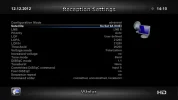
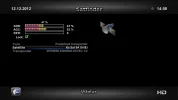
Here are a few pictures of VU+ receiver setting to get RTE in Ka band. The satellite receiver is Vu+ Uno with Black Hole image + EMP Centauri S 8/1PCP-W2 (P.168-W) DiseqC switch .....
I would recommend a fixed dish instead of fitting an Inverto Ka band lnb on the motor. This lnb has really limited use.

By the way Right-handed circular polarization is the one that should be used. There`s no mistake even the official source (including the information in the RTE stream), lyngsat (have a chat with Mr Lyngemark about it) or flysat say Left-handed circular polarization is used. It is not!
 

Attachments

  • DiseqC setting.webp
    DiseqC setting.webp
    33.4 KB · Views: 330
  • Satfinder.webp
    Satfinder.webp
    22.6 KB · Views: 349
  • RTE 2 HD.webp
    RTE 2 HD.webp
    77.2 KB · Views: 350
  • Serviceinfo.webp
    Serviceinfo.webp
    47.3 KB · Views: 303
Nice to see one of my attachments (post 29) actually worked!
satosk - you're not receiving those pictures in Slovakia are you?
 
NoviceSat said:
Nice to see one of my attachments (post 29) actually worked! satosk - you're not receiving those pictures in Slovakia are you?
Hi NoviceSat,

pictures were taken in N.Ireland, co.Armagh....
I just wanted to show you how to set up the Local Oscilator on the receiver to get proper frequencies in Ka band. It is much easier than converting (calculating) real frequency to Ku range all the time.
 
After recent tests i can confirm RTE is receivable in EXETER but not 17 miles east @LYME REGIS.
Thanks to this nice thread _ Contains some interesting info.
I have used various size dishes _
A 60cm solid triax dish with triax LNB worked in exeter with a Strong Receiver.
Various dishes used in lyme regis from 60cm to 120, All solid - Same result every time = Blank screen.
Hope this helps anyone interested.
 
Is it likely to work in Wales on the Llyn peninsula? We have a holiday home there, so can easily give it a try.
 
Is it likely to work in Wales on the Llyn peninsula? We have a holiday home there, so can easily give it a try.

Yes it is . I have tested it and it should be OK. Be sure you have the right LNB, receiver (HD model), and align first at 9 east using ordinary LNB. I used a 40cm solid dish for testing, as it is less directional, but an 80cm or larger would be needed for reliable pictures during rainstorms.]

Let us know how you get on
 
By the way Right-handed circular polarization is the one that should be used. There`s no mistake even the official source (including the information in the RTE stream), lyngsat (have a chat with Mr Lyngemark about it) or flysat say Left-handed circular polarization is used. It is not!

I think the left hand circular polarisation or right hand circular debate is a bit confusing. Firstly the signal hitting a dish will cause the polarisation to become oppose (this is a circular polarisation thing) so the LNB polarisation vs the signal from the satellite polarisation is opposite. Also in the USA all the LNBs seem to use 13V for Left hand and 18V for Right hand, but the EU LNB from Eurtelsat is the exact opposite! If you use crazyscan or any receiver that has a circular polarisation option, the software will generally be written for the USA and so it will apply 13V instead of 18V and vice versa. See the USA had a standard and the EU created a better OPPOSITE standard. I never bothered to ask the crazyscan guy to make an option for Circular EU and Circular USA!

LHCP polarization = 13V for EU KA
RHCP polarization 18V for EU KA

Input Frequency Range 19.7 ~ 20.2 GHz
Output Frequency Range 1500 ~ 1000 MHz (spectrum inversion)
Low Band LO Frequency 21.20 GHz (there is only one LO)
Polarization Dual circular for Ka band (RHCP/LHCP)
 
Last edited:
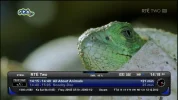
I have finally managed to watch Irish TV on 9.0E - but I had to cheat and take my setup to 50.1N, 5.5W (Is it bad to take a satellite dish on holiday with you? :eek:)
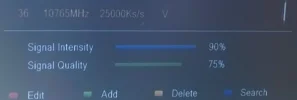
I used my somewhat battered 78cm mesh dish (I think perforated would be a better description) and received 90% signal strength and 75% signal quality - weather was sunny with occasional cloud.
After all this, there wasn't much on during the day - so a bit of an anti-climax!
 
Always take pictures when on holiday...
9e_3.webp

And some Irish TV snapshots...

9e_1.webp 9e_2.webp
 

for ka-band frequencies we have not
still a good satellite receiver!!
example::
dreambox 7080
vu+duo2
it isn t good for ka-band with high frequeny
21.2-22.2 GHz

is there a good satellite receiver for high frequeny (21.2-22.2 GHz)?
==================================================
only dvb cards are ok
etc::tbs 6983​
 
Back
Top