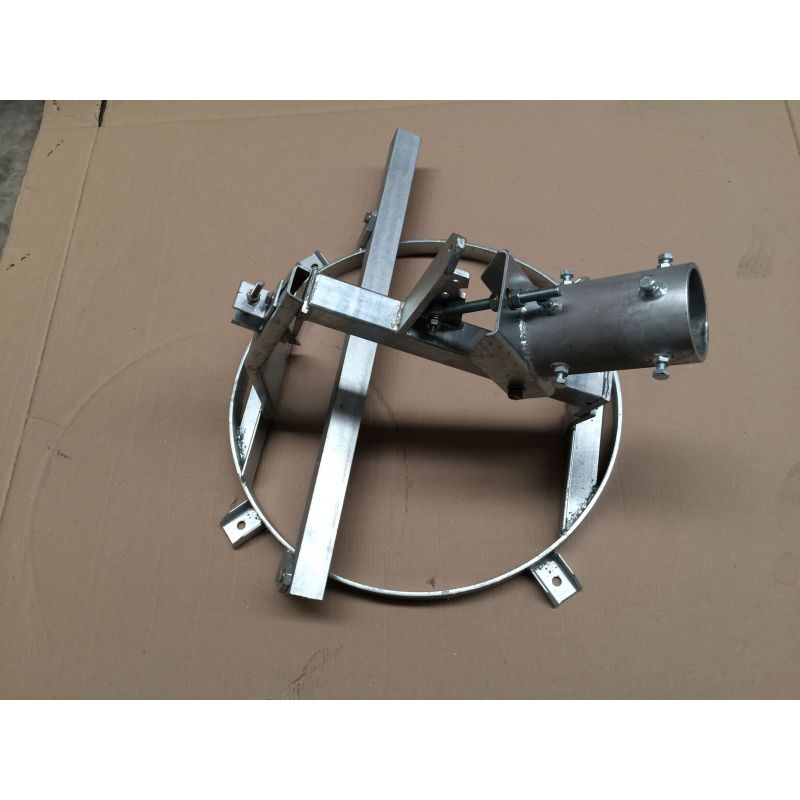
Help Required Raven 1.8m motorised dish/polar mount instructions needed

Just called 'Inclinometer' I got it from the Play Store.
couldn't get that one to work on my phone but I got 1 called clinometer to work and it says 30.3 degrees so it looks like you are right.
cheers for the advice

Mark
 
Hope it works out well. My stuff above was considering a prime focus dish. So taking in account of the 22.5 degree (??) 'look angle' of your offset dish needs to be factored in also. So the initial setup would have your dish face a negative 22.5 degrees down from the polar angle. Then add an additional X degrees to it for declination.

Here's a pic of a pair of Raven dishes in London. On a H-H mount. Same setup as a polar mount.
Red arrows would be dish face/polar angle equal. Remember the look angle of the dish being 22.5 degrees.
So....add that to the polar angle and you end up with the blue arrow. After you calculate declination, the dish ends up at the green arrow.

For all future self installers. Do not waste a single penny on an inclinometer. Get a digital angle gauge. You will thank yourselves later. 1/10th degree resolution is tons better than guessing.
The two inclinometers I have owned in 40 years of work have been good to around 5 minutes, or 1/12 of a degree.

They have been fine for everything I have installed up to 12GHz and 5m in diameter, perhaps you should speak to your supplier.
 
The two inclinometers I have owned in 40 years of work have been good to around 5 minutes, or 1/12 of a degree.

They have been fine for everything I have installed up to 12GHz and 5m in diameter, perhaps you should speak to your supplier.
Sir. I do not wish to argue. The ones you see advertised on the common sites that indicate even to one degree require a lot of squinting to see it.
And interpolating to 1/2 degree is even harder and more difficult to reproduce.
With the instruments you tout that you have. You must certainly be a proud person. I would think that you could estimate down to the 1/10th mph in the old MG. Hah! But you have to tap the glass a few times to guess it, don't you.
For the same and even less money for a digital angle gauge that you can see down to 1/10th degree from feet away w/o glasses.
Who could argue. Welcome to 2025.
Darned handy if you make a small adjustment to a polar mount and you need to go the other way. Or just a touch more. Or go back to start.
Please show a picture of your fine instruments.
I can still use a slide rule. Do I wish to? Nah.
 
I don't know if it's the same system but here is the manual for Channel master 1.2m polar mount:

1000074439.webp

1000074440.webp


and here is the inclinometer I used, bought less than 10e on Amazon, very useful:

1000074599.webp
 
I don't know if it's the same system but here is the manual for Channel master 1.2m polar mount:

View attachment 162982

View attachment 162983


and here is the inclinometer I used, bought less than 10e on Amazon, very useful:

View attachment 162984
The genuine polarmount for the CM/Raven 1.8 is a lot more substantial than the 1.2m design, which is why it was probably discontinued.

Orbita make something for the 1.8m reflector.

 
Sir. I do not wish to argue. The ones you see advertised on the common sites that indicate even to one degree require a lot of squinting to see it.
And interpolating to 1/2 degree is even harder and more difficult to reproduce.
With the instruments you tout that you have. You must certainly be a proud person. I would think that you could estimate down to the 1/10th mph in the old MG. Hah! But you have to tap the glass a few times to guess it, don't you.
For the same and even less money for a digital angle gauge that you can see down to 1/10th degree from feet away w/o glasses.
Who could argue. Welcome to 2025.
Darned handy if you make a small adjustment to a polar mount and you need to go the other way. Or just a touch more. Or go back to start.
Please show a picture of your fine instruments.
I can still use a slide rule. Do I wish to? Nah.
I can also use a slide rule (and log books if pushed).

A mechanical inclinometer is only as good as the person using it. The ones here hasve a 300mm baseline and a clear dial around 100m in diameter.

Calibrated using the ground post (backed up by a long line spirit level) reading down to 15 minutes is a doddle in all weathers, 5 minutes requires moving either side of the polarmount and perhaps returning to the post to ensure nothing has moved.

In 20 years of use, neither has required a replacement battery either.
 

Attachments

  • 20230118_180146.webp
    20230118_180146.webp
    320.7 KB · Views: 33
  • 20210831_224750.webp
    20210831_224750.webp
    227.3 KB · Views: 35
I have the version for CM 2.4m by Primesat (or SSS, it is the same). It is very heavy, solid and stable. And I believe that they can easily supply the 1.8m version too.
That's the one I have (the 1.8 version).
 
I don't know if it's the same system but here is the manual for Channel master 1.2m polar mount:

Looking at fig. 3.3 on page 12 from that manual, as shown in your picture, I wonder what the second and third picture are used for?
A vertical measurement on the dish face, with the (offset!) dish in a rotated position?
I cannot think of a sensible use for that.

So, can you tell me how the procedure for fig 3.3 is described?
I do have a few Channel Master manuals on my hard disc, but none have the same picture, alas.

Greetz,
A33
 
Looking at fig. 3.3 on page 12 from that manual, as shown in your picture, I wonder what the second and third picture are used for?
A vertical measurement on the dish face, with the (offset!) dish in a rotated position?
I cannot think of a sensible use for that.

So, can you tell me how the procedure for fig 3.3 is described?
I do have a few Channel Master manuals on my hard disc, but none have the same picture, alas.

Greetz,
A33
You will need the other pages within the assembly manual (model 6033), though only page 10 is on this site.

 
Looking at fig. 3.3 on page 12 from that manual, as shown in your picture, I wonder what the second and third picture are used for?
A vertical measurement on the dish face, with the (offset!) dish in a rotated position?
I cannot think of a sensible use for that.

So, can you tell me how the procedure for fig 3.3 is described?
I do have a few Channel Master manuals on my hard disc, but none have the same picture, alas.

Greetz,
A33
Cutting to the chase. Only the first illustration on 3.3 should be your main focus when setting up the dish.

Being also an astronomy buff with a telescope equipped with a polar mount. We need to make some hard comparisons.
The polar axis of both telescope and "modified German polar mount" of the satellite polar mount need to be setup to aimed at true North.
Not magnetic North as a compass would show. And for every location on the planet, there are updated tables that show the compensations needed. Aircraft uses it, surveyors do it too. Although with GPS it has become a no-brainer. But still, using a magnetic compass, displayed North is not true North.
Check?

So the elevation angle of both types of mounts must be adjusted to the true North angle. Imagine a spike stabbed through the earth that passes exactly through the true North and South poles. Imagine your particular location. You see from a chart, Google Earth. Whatever. Your latitude is X degrees. Standing at the North pole looking straight up in the sky along the spike that was stabbed in.
You will see the North Star. Well. with your dish mount perfectly set for the elevation angle. Or the telescope mount. Your next task will be to swing the entire mount on the pole to point at true North. Your elevation, polar angle will match the same angle of the spike. Parallel. But.....
Swinging the mount on the pole left or right will be done to point the pivots and elevation arm exactly the same as the telescope mount.
At night with a spotting scope mounted on your dish elevation arm. Exactly in line with the pivots by every possible means.
Wa-La! Look through the scope and there's the North Star. That's the concept. You do it once. An astronomer with a portable polar mount does it every single night of star gazing.
Check?

Now. To aim the dish on the pole so that the mount (and dish at zenith.....the highest point it can be pointed in the sky). Get it in the neighborhood.
A prime focus dish has it's own dish face at 0 declination. As would an offset dish like the Raven/ChannelMaster variants shown here.
But a prime focus dish face set at 0 declination would be parallel to the elevation angle as looked at from the side.
The specs for the offset dishes shown here show a look angle of 22.5-22.6 degrees. You could still set the dish face measured vertically across the the face to be parallel with the elevation pivots. But it's not usually done.
Laying a straight edge horizontally across the face of the dish and fastened so that it stays put. And the angle measurement device Du-jour laid on top of it. You turn the dish on the pivots (not the pole) until it reaches the highest in the sky it can possibly go. Use ratchet straps, the motorized actuator. The dish will be at zenith. At that point use whatever method you can to move the entire mount on the pole so that the dish is aimed at true South. Dish Pointer, a smart phone AI app. Use landmarks shown in the display. When set. Bolt the mount to the pole.
A very good time now is to make a Sharpie mark on the mount and pole for tweaks needed later on.
Check

Illustration 3.3 is if the dish were set at zentih. Other's there. you really should think of as goose-down fuzzy-stuff that has you wondering and thinking too much.
It was mentioned the look angle of these dishes versus a prime focus dish. Prime focus zero declination angle equals the elevation, polar angle at zentith.
Offset dishes here start out zero declination angle (mechanically) plus the 22.6 degree look angle engineered into them.
The adjustment bolt for declination adjustment for a factory mount states something like precise. Take that with two grains of salt. Close? Sure.
But after everything mount related is setup. There will be many tweaks needed to get the mount tracking.
A fabricated mount will probably have no degree markings stamped in or marked adjustment bolts.
As a fortification. No lathe, mill in the past 20+ years has a machinist using the vernier dials. Instead there are DRO units that carry out measurements and settings to four and more decimal places. Relatively cheap and highly accurate and repeatable.
If you have an inclinometer in the drawer. Fine. If you don't have and need a precision device to assist. Go digital as is shown above.
I forgot to shut mine off and it went to sleep. Another older one w/o sleep was in its pouch for a week and the display was still on.
Even Fred Flintstone got tired of winding his Timex and got a Swatch. And it had a 3 year old battery in it, accurate to one second per day.
Check-a-mundo.

I'm in the USA. I enjoy the hobby and helping others pull their dishes out of mothballs in the weather for many years.
My main receptions are C Band. And many, I am in the fringe of transponder coverage. I forget that ku band has a bit of wiggle room as far as signal strength is concerned. But. With C Band and the difference in dish mover "counts" being as little as 6 either way from max. signal to loss of lock, pixels. Ku Band can be up to 20 from target. And I never realized the reason for "ignoring adjacent satellites up to X degrees" setting in the scan menu. So I guess being a bit sloppy in Ku dish setup is okay. But it's 2025. Get a digital angle gauge. For God sakes! Or have a yabba-dabba-do time!!!

Need illustrations? I have a ton. Ax me.

 
Cutting to the chase. Only the first illustration on 3.3 should be your main focus when setting up the dish.

Being also an astronomy buff with a telescope equipped with a polar mount. We need to make some hard comparisons.
The polar axis of both telescope and "modified German polar mount" of the satellite polar mount need to be setup to aimed at true North.
Not magnetic North as a compass would show. And for every location on the planet, there are updated tables that show the compensations needed. Aircraft uses it, surveyors do it too. Although with GPS it has become a no-brainer. But still, using a magnetic compass, displayed North is not true North.
Check?

So the elevation angle of both types of mounts must be adjusted to the true North angle. Imagine a spike stabbed through the earth that passes exactly through the true North and South poles. Imagine your particular location. You see from a chart, Google Earth. Whatever. Your latitude is X degrees. Standing at the North pole looking straight up in the sky along the spike that was stabbed in.
You will see the North Star. Well. with your dish mount perfectly set for the elevation angle. Or the telescope mount. Your next task will be to swing the entire mount on the pole to point at true North. Your elevation, polar angle will match the same angle of the spike. Parallel. But.....
Swinging the mount on the pole left or right will be done to point the pivots and elevation arm exactly the same as the telescope mount.
At night with a spotting scope mounted on your dish elevation arm. Exactly in line with the pivots by every possible means.
Wa-La! Look through the scope and there's the North Star. That's the concept. You do it once. An astronomer with a portable polar mount does it every single night of star gazing.
Check?

Now. To aim the dish on the pole so that the mount (and dish at zenith.....the highest point it can be pointed in the sky). Get it in the neighborhood.
A prime focus dish has it's own dish face at 0 declination. As would an offset dish like the Raven/ChannelMaster variants shown here.
But a prime focus dish face set at 0 declination would be parallel to the elevation angle as looked at from the side.
The specs for the offset dishes shown here show a look angle of 22.5-22.6 degrees. You could still set the dish face measured vertically across the the face to be parallel with the elevation pivots. But it's not usually done.
Laying a straight edge horizontally across the face of the dish and fastened so that it stays put. And the angle measurement device Du-jour laid on top of it. You turn the dish on the pivots (not the pole) until it reaches the highest in the sky it can possibly go. Use ratchet straps, the motorized actuator. The dish will be at zenith. At that point use whatever method you can to move the entire mount on the pole so that the dish is aimed at true South. Dish Pointer, a smart phone AI app. Use landmarks shown in the display. When set. Bolt the mount to the pole.
A very good time now is to make a Sharpie mark on the mount and pole for tweaks needed later on.
Check

Illustration 3.3 is if the dish were set at zentih. Other's there. you really should think of as goose-down fuzzy-stuff that has you wondering and thinking too much.
It was mentioned the look angle of these dishes versus a prime focus dish. Prime focus zero declination angle equals the elevation, polar angle at zentith.
Offset dishes here start out zero declination angle (mechanically) plus the 22.6 degree look angle engineered into them.
The adjustment bolt for declination adjustment for a factory mount states something like precise. Take that with two grains of salt. Close? Sure.
But after everything mount related is setup. There will be many tweaks needed to get the mount tracking.
A fabricated mount will probably have no degree markings stamped in or marked adjustment bolts.
As a fortification. No lathe, mill in the past 20+ years has a machinist using the vernier dials. Instead there are DRO units that carry out measurements and settings to four and more decimal places. Relatively cheap and highly accurate and repeatable.
If you have an inclinometer in the drawer. Fine. If you don't have and need a precision device to assist. Go digital as is shown above.
I forgot to shut mine off and it went to sleep. Another older one w/o sleep was in its pouch for a week and the display was still on.
Even Fred Flintstone got tired of winding his Timex and got a Swatch. And it had a 3 year old battery in it, accurate to one second per day.
Check-a-mundo.

I'm in the USA. I enjoy the hobby and helping others pull their dishes out of mothballs in the weather for many years.
My main receptions are C Band. And many, I am in the fringe of transponder coverage. I forget that ku band has a bit of wiggle room as far as signal strength is concerned. But. With C Band and the difference in dish mover "counts" being as little as 6 either way from max. signal to loss of lock, pixels. Ku Band can be up to 20 from target. And I never realized the reason for "ignoring adjacent satellites up to X degrees" setting in the scan menu. So I guess being a bit sloppy in Ku dish setup is okay. But it's 2025. Get a digital angle gauge. For God sakes! Or have a yabba-dabba-do time!!!

Need illustrations? I have a ton. Ax me.
Stars move in relation to the earth, check.

Geostationary satellites are named since they maintain (within a small margin) position and distance relative to the planet, as long as they have fuel and the teleport staff don't push the wrong buttons.

The manual for the CM design is over 30 years old but the picture/procedure inside are still relevant to those that can get by with an inclinometer, old or new.
 
Illustration 3.3 is if the dish were set at zentih.

That is valid for the first picture in fig. 3.3; that is clear, that is dish at zenith/apex.

But what are the second and third picture of fig 3.3 for?
And what is meant with fig. 3.1 and 3.2 (3.2 is alas missing in the link that @Channel Hopper posted): what are the curved lines from 65 to 92.5 for?

Greetz,
A33
 
Maybe check the elevation of the westernmost and easternmost satellite?
 
Page 9 onwards may be the same in this attachment.
 

Attachments

a33. Try to think of a fixed az-el mount. For your location from tables you select your target satellite.
Several bits of information are given. Elevation above the horizon, azimuth, and skew of the lnbf/dish.
Through the arc a polar mount takes care of those things if setup properly for true South.
The two illustrations hint if you are aimed at a particular satellite West or East of the initial setup at the exact elevation indicated in charts for a fixed dish. And the dish is pointed at the exact azimuth angle for that satellite.
If the elevation is either too high or too low. Then the true South, turn the entire dish on the pole, needs to be tweaked in.
Compare with the tuning of the arc diagram that I put up previously. And think how turning the dish on the pole can make, for example, a western satellite where the dish is tracking a touch low. But an eastern satellite tracks a touch high.
And for any dish setup you don't measure using the skew angle. A plumb, level with the pole in the dirt, straight edge is used.
CM_Azimuth.webp
 
a33. Try to think of a fixed az-el mount. For your location from tables you select your target satellite.
Several bits of information are given. Elevation above the horizon, azimuth, and skew of the lnbf/dish.
Through the arc a polar mount takes care of those things if setup properly for true South.
The two illustrations hint if you are aimed at a particular satellite West or East of the initial setup at the exact elevation indicated in charts for a fixed dish. And the dish is pointed at the exact azimuth angle for that satellite.
If the elevation is either too high or too low. Then the true South, turn the entire dish on the pole, needs to be tweaked in.
Compare with the tuning of the arc diagram that I put up previously. And think how turning the dish on the pole can make, for example, a western satellite where the dish is tracking a touch low. But an eastern satellite tracks a touch high.
And for any dish setup you don't measure using the skew angle. A plumb, level with the pole in the dirt, straight edge is used.
View attachment 163015
So, the CM manual was written by an imbecile ?
 
So, the CM manual was written by an imbecile ?
You know. A police officer told me once. "If they anger you, they have won". Please get off of your soap box and offer some plausible answers.
Books and education are great things. Hands on, school of hard knocks experience comes after. I understand that your tiny dishes there are the only legal sizes that can be used. And that hinders c band reception for all but the strongest transponders.
CM, Raven, Andrews all made the same dish. There are many polar mounts. The concept is all the same. There are of course az-el movable mounts with controllers that provide accurate steering. Get in the Triumph and take a jaunt to Jodrell Bank. If the Lucas Electrics don't bork on the way.
What??? Is your beef? Have you offered any viable and easy to understand explanations and concepts to attain proper polar mount satellite dish setup and tracking? Questions asked from the manuals by folks like a33 are good. And deserve an answer. Not a nondescript "probably".
And we can all agree that for a noobie that has never ever placed a satellite dish and received that very first signal from guides. It could be a bit frustrating and overwhelming. Just suggesting that a 30 year old axe is just as good as a chainsaw in this age is preposterous. Especially when today, both cost the same. But one is guaranteed to drop a tree exactly where it's supposed to almost every-single-time.
So. I offer you the rest of this post and expect clear, concise answers. I believe that everyone else here can agree.
 
Back
Top